
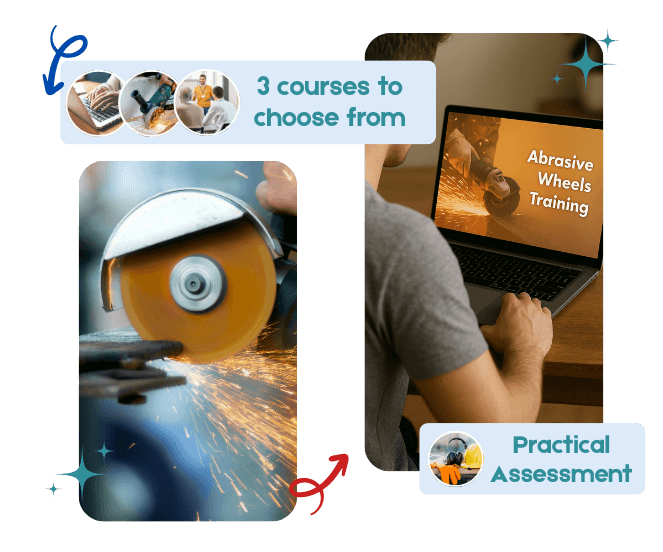
Abrasive Wheels Training
3 Courses to Choose From



Frequently Asked Questions about Abrasive Wheels Training
Abrasive wheels training is a safety course that teaches workers how to recognise the hazards of using cutting and grinding wheels, understand the legal requirements, and follow safe working practices. The training covers topics such as machine setup, wheel types, PPE, storage, and handling.
⚠️ It’s important to note that this online course provides knowledge only. Anyone who will actually use abrasive wheels must also receive hands-on practical training from their employer as required by law.
- Introduction and legal framework
- Abrasive wheel types, bonds and characteristics
- Wheel markings, labels and certification
- Inspection and pre-use cheques
- Mounting, balancing and fitting
- Safe operating practices
- Storage handling and transport
Knowledge training must always be followed by on-the-job experience and supervision. With training on the specific equipment you are using being provided by the employer.
Whichever training you choose, it must always be followed by on-the-job practice and supervision. With training on the specific equipment you are using, provided by the employer.
Before any training is provided, the employer must carry out a risk assessment to identify if there is a way the job can be done that does not require an abrasive wheel, if not you must implement controls, such as safe systems of work, equipment, training, PPE and supervision. We've list the full details below:-
1. Provide Training & Authorisation (Ireland only)
-
Ensure all operators receive suitable abrasive wheels training.
-
Training must include hazards, legal duties, mounting, guards, PPE, storage, and safe use.
-
Keep records of training and authorisation for each employee.
-
Untrained or unauthorised staff must not mount or use abrasive wheels.
2. Safe Equipment & Maintenance
-
Provide machinery that is fit for purpose and compliant with standards.
-
Fit all machines with guards, tool rests, and safety devices.
-
Match wheels and machines correctly (speed, size, mounting).
-
Maintain and inspect equipment regularly; remove defective wheels or machines from use.
3. Risk Assessment & Safe Systems of Work
-
Carry out a risk assessment for abrasive wheel operations.
-
Identify hazards such as wheel breakage, dust, vibration, noise, and sparks.
-
Develop and implement safe systems of work to control risks.
-
Review assessments when equipment, work practices, or legislation changes.
4. Provide PPE
-
Supply employees with suitable personal protective equipment:
-
Eye and face protection (goggles/visors)
-
Hearing protection
-
Respiratory protection (if dust present)
-
Gloves and protective clothing
-
-
Ensure PPE is maintained and worn properly at all times.
5. Supervision & Monitoring
-
Allow only trained and authorised staff to mount or use abrasive wheels.
-
Supervise workers to ensure procedures are followed.
-
Prevent unsafe practices such as removing guards or using damaged wheels.
6. Storage, Handling & Transport
-
Provide safe storage for abrasive wheels to prevent damage.
-
Ensure wheels are transported carefully (protected, not dropped or knocked).
-
Train employees in correct handling methods.
7. Record Keeping, Incidents & Refresher Training
-
Keep records of training, authorisation, inspections, and maintenance.
-
Ensure accidents, near misses, or wheel failures are reported and investigated.
-
Provide refresher training at least every 3 years, or sooner if:
-
New equipment is introduced
-
Legislation changes
-
An incident or near miss occurs
-
🔄 Refresher Training for Abrasive Wheels
-
No fixed legal expiry date is written into PUWER (UK) or Irish legislation.
-
However, both the HSE (UK) and HSA (Ireland) state that training must be kept up to date and refreshed periodically.
Typical Industry Practice
-
Every 3 years – the common recommendation for abrasive wheels refresher training.
-
Sooner if:
-
There are changes in equipment or processes.
-
There are changes in legislation or standards.
-
An employee is involved in an incident, near miss, or unsafe practice.
-
Supervisors identify a skills or knowledge gap.
-
Why?
Because abrasive wheels present high-risk hazards (wheel breakage, ejection of fragments, dust, vibration), ongoing competence is essential.
✅ In short: Most organisations refresh abrasive wheels training every 3 years, but it must be done sooner whenever risks, equipment, or roles change.
Still have questions?

Ready to ensure your team can
See the HSA Ireland and HSE UK Guidance on abrasive wheels Training - Click to Follow