The Complete Guide to People Handling and Moving Training in 2026
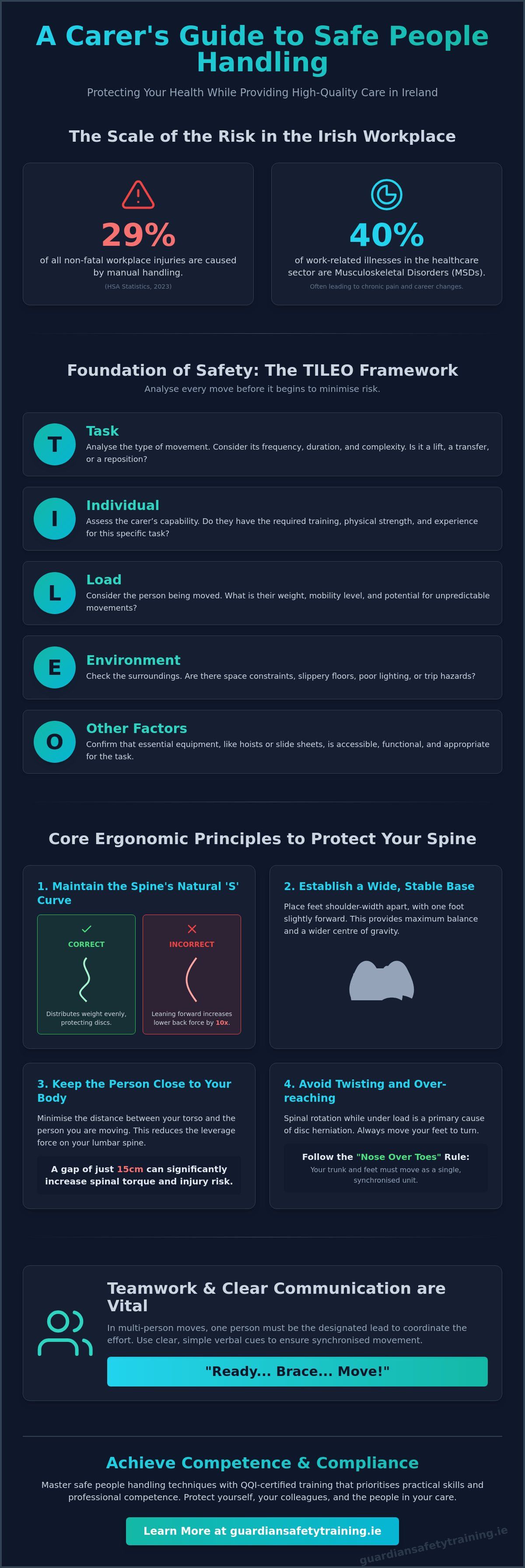
The TILEO Framework for Risk Assessment
Ergonomic Principles: Protecting the Caregiver’s Spine
The Dangers of Twisting and Over-Reaching
The Dangers of Twisting and Over-Reaching
Communication and Synchronisation
Essential Techniques for Common People Transfers
Lateral Transfer Best Practices
Dealing with the Unpredictable: The Fallen Person
Mechanical Aids and Environmental Risk Management
Selecting the Right Sling and Hoist
Environmental Modifications
Accredited Training: Building Competence in People Handling
The People Handling Instructor Path (QQI Level 6)
Choosing the Right Training Format
Frequently asked questions
Is it ever legal to manually lift a person in Ireland?
Manual lifting of a person should be avoided in all but the most extreme, life-threatening emergencies where using equipment is not possible. The HSA's official policy is to promote a minimal-lifting approach, relying on modern equipment and techniques instead.
How often do healthcare staff need people handling refresher training?
While there is no strict legal timeframe, best practice guidelines in Ireland recommend that refresher training is conducted at least every two to three years, or more frequently if there is a change in work practices, new equipment is introduced, or an incident occurs.
What is the TILEO acronym in safe people handling?
TILEO is a risk assessment tool used to remember the key factors to consider before any handling task: Task, Individual (the carer), Load (the person), Environment, and Other factors (like equipment).
Can one person safely use a hoist?
This depends entirely on the organisation's risk assessment. While some modern hoists are designed for single-carer use, it is often recommended that two people are present—one to operate the hoist and another to support and reassure the person being moved.
What should I do if a person refuses to use a mechanical aid?
First, try to understand their concerns. They may be frightened or misinformed. Calmly explain why the equipment is necessary for both their safety and the carer's. If they still refuse, you must document this, reassess the situation, and explore alternative safe methods. You must not proceed with a manual lift against policy.
What are the most common injuries caused by poor people handling?
The most common injuries for caregivers are musculoskeletal disorders (MSDs), particularly chronic lower back pain, shoulder strain, and disc injuries. For the person being handled, risks include skin tears, bruising, dislocations, and falls.
Does a manual handling certificate cover people handling?
No. A general manual handling certificate covers the moving of inanimate objects. People handling requires specialised training that addresses the unique challenges of moving people, including dignity, communication, and the use of specific medical equipment.
What is the role of a People Handling Instructor?
A qualified People Handling Instructor is responsible for training staff in safe handling techniques, conducting site-specific risk assessments, advising on appropriate equipment, and helping to foster a strong safety culture within a healthcare or social care organisation.